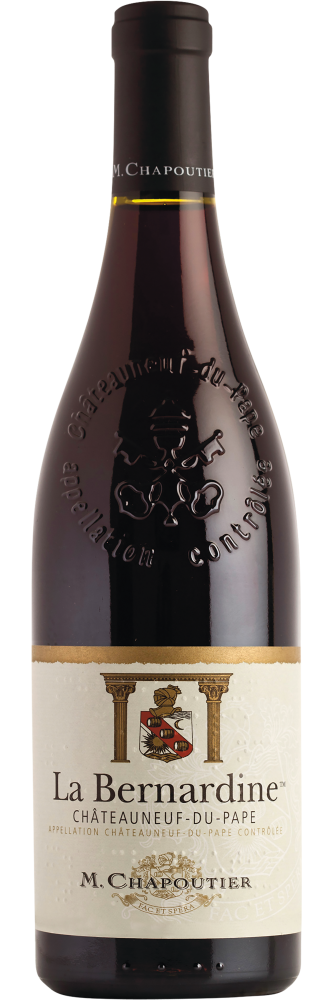
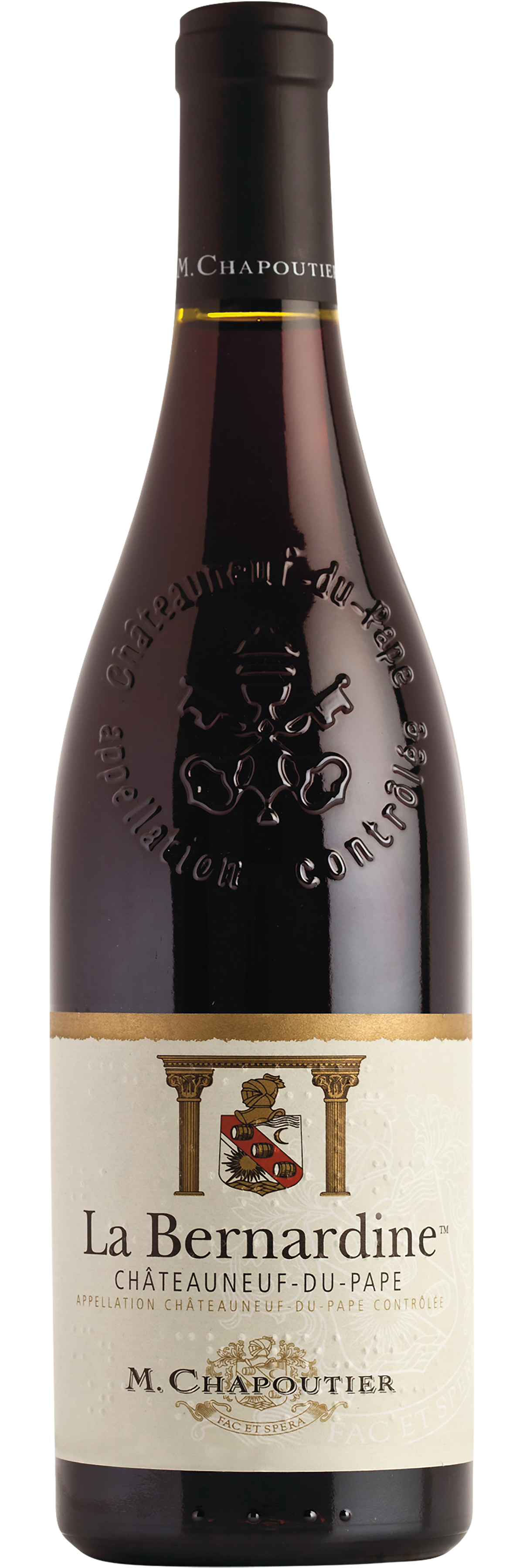
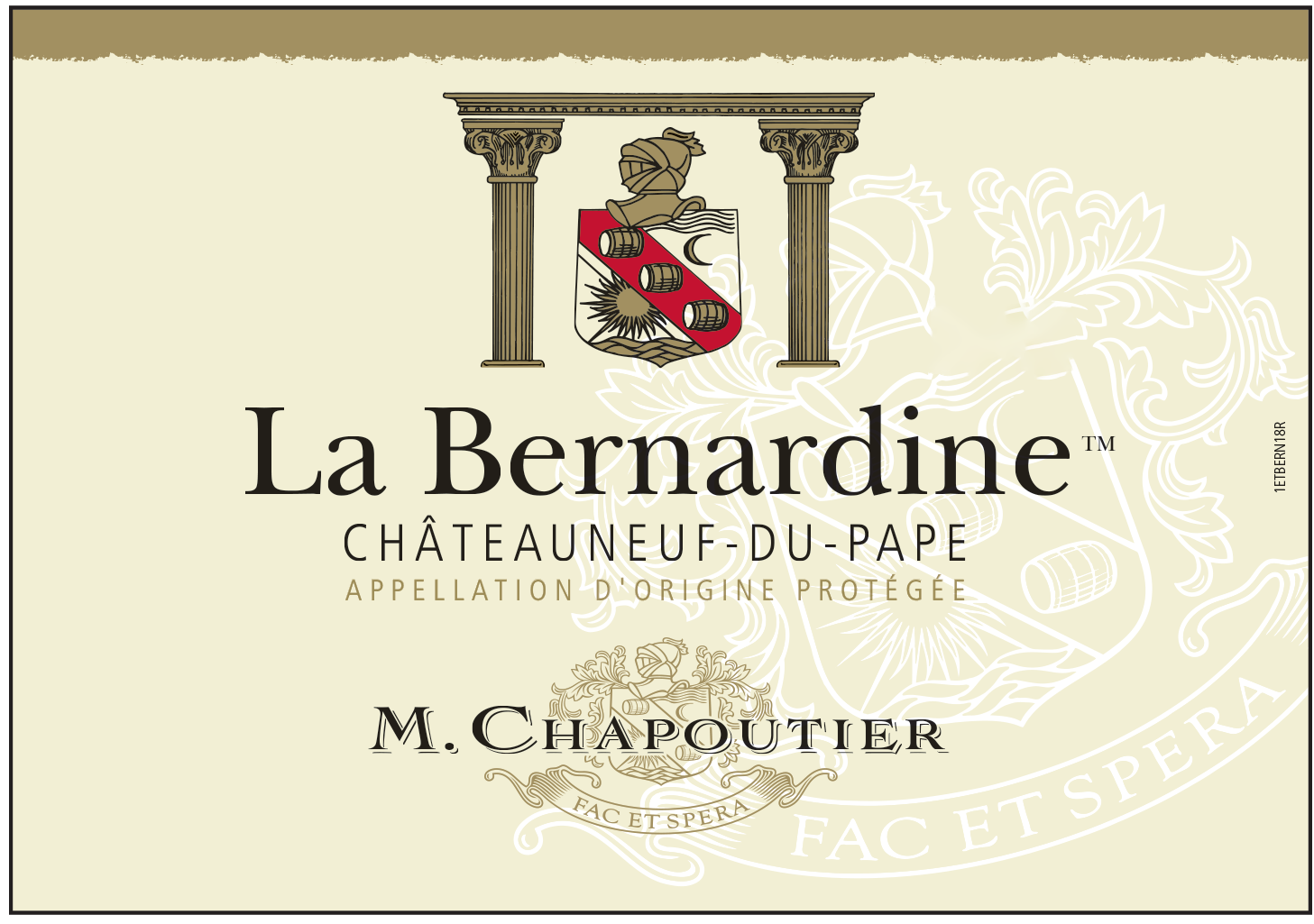
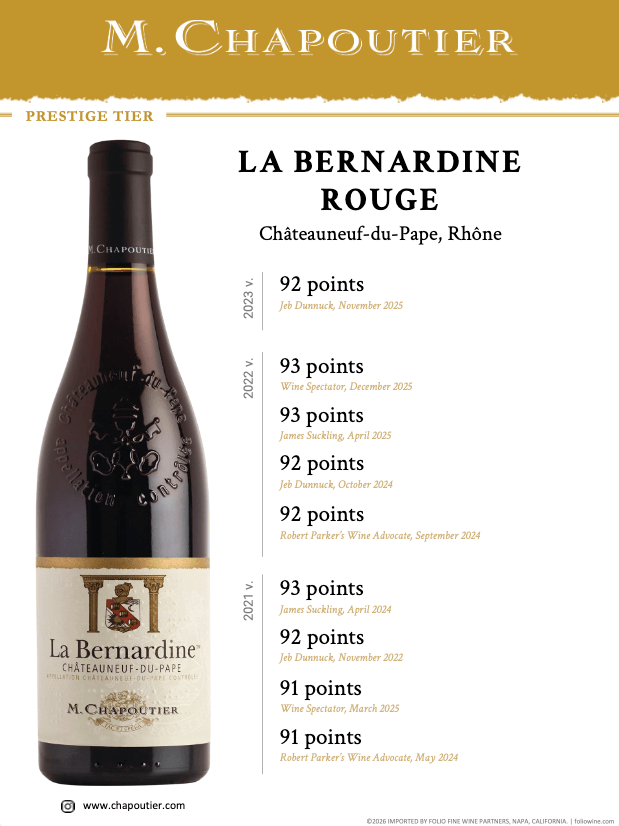
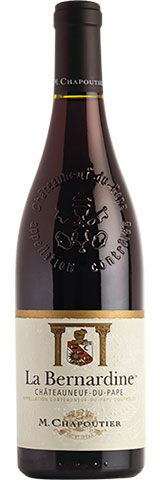
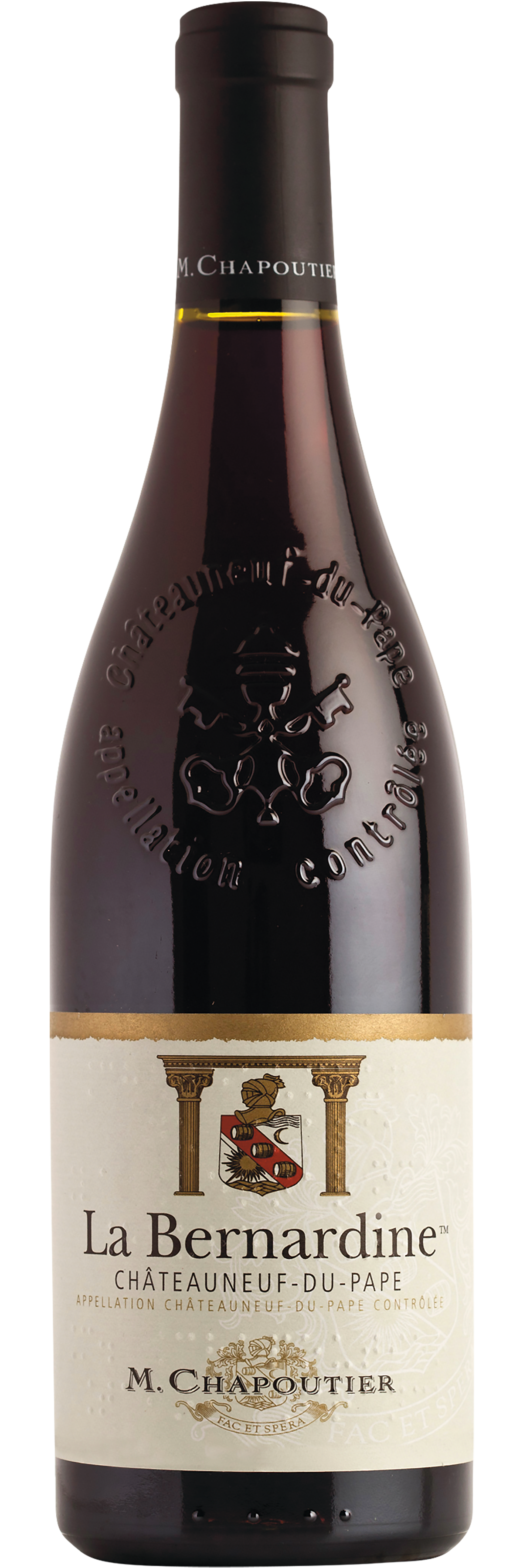
M. Chapoutier La Bernardine Rouge

AOC Châteauneuf-du-Pape, Rhône, France

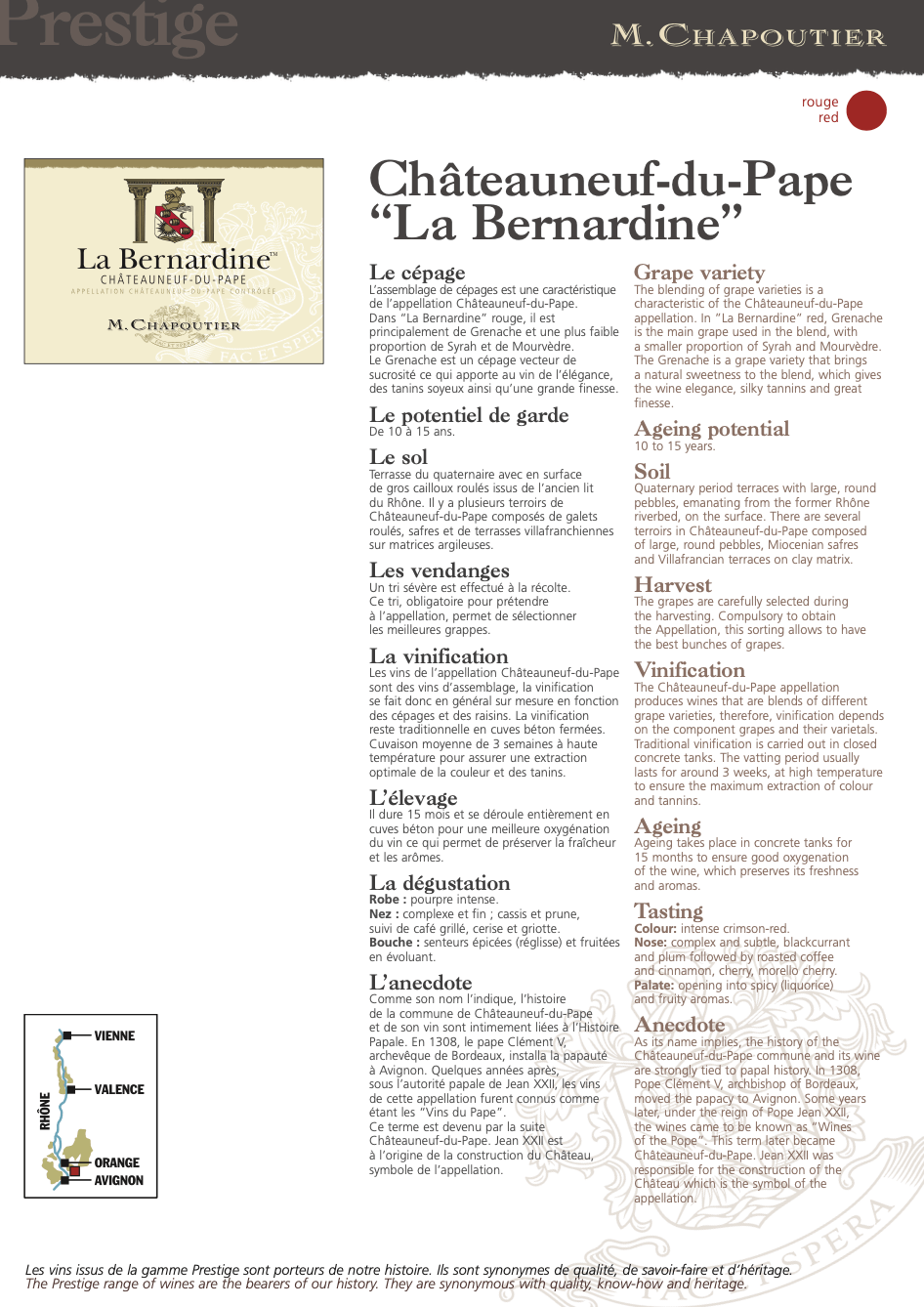
The blending of grape varieties is a characteristic of the Châteauneuf-du-Pape appellation. In "La Bernardine" red, Grenacheis the main grape used in the blend, with a smaller proportion of Syrah and Mourvèdre. Grenache is a grape variety that brings a natural sweetness to the blend, which gives the wine elegance, silky tannins and great finesse.

Tasting Notes

Colour: Intense crimson-red.
Nose: Complex and subtle, blackcurrant and plum followed by roasted coffee and cinnamon, cherry, morello cherry.
Palate: Opening into spicy (liquorice) and fruity aromas.

Grilled and roasted red and white meats, including leg of lamb or garlic roasted chicken. Vegetarian moussaka with lentils is also an excellent choice.

The grapes are carefully selected during the harvesting. Compulsory to obtain the Appellation, this sorting allows to have the best bunches of grapes.

The Châteauneuf-du-Pape appellation produces wines that are blends of different grape varieties, therefore, vinification depends on the component grapes and their varietals. Traditional vinification is carried out in closed concrete tanks. The vatting period usually lasts for around 3 weeks, at high temperature to ensure the maximum extraction of colour and tannins. Ageing takes place in concrete tanks for 15 months to ensure good oxygenation of the wine, which preserves its freshness and aromas.

As its name implies, the history of the Châteauneuf-du-Pape commune and its wine are strongly tied to papal history. In 1308, Pope Clément V, archbishop of Bordeaux, moved the papacy to Avignon. Some years later, under the reign of Pope Jean XXII, the wines came to be known as “Wines of the Pope”. This term later became Châteauneuf-du-Pape. Jean XXII was responsible for the construction of the Château which is the symbol of the appellation.

Quaternary period terraces with large, round pebbles, emanating from the former Rhône riverbed, on the surface. There are several terroirs in Châteauneuf-du-Pape composed of large, round pebbles, Miocenian safres and Villafrancian terraces on clay matrix.

Varietals: Grenache is the main grape used in the blend, with a smaller proportion of Syrah and Mourvèdre

The blending of grape varieties is a characteristic of the Châteauneuf-du-Pape appellation. In "La Bernardine" red, Grenacheis the main grape used in the blend, with a smaller proportion of Syrah and Mourvèdre. Grenache is a grape variety that brings a natural sweetness to the blend, which gives the wine elegance, silky tannins and great finesse.

Tasting Notes

Colour: Intense crimson-red.
Nose: Complex and subtle, blackcurrant and plum followed by roasted coffee and cinnamon, cherry, morello cherry.
Palate: Opening into spicy (liquorice) and fruity aromas.

Grilled and roasted red and white meats, including leg of lamb or garlic roasted chicken. Vegetarian moussaka with lentils is also an excellent choice.

The grapes are carefully selected during the harvesting. Compulsory to obtain the Appellation, this sorting allows to have the best bunches of grapes.

The Châteauneuf-du-Pape appellation produces wines that are blends of different grape varieties, therefore, vinification depends on the component grapes and their varietals. Traditional vinification is carried out in closed concrete tanks. The vatting period usually lasts for around 3 weeks, at high temperature to ensure the maximum extraction of colour and tannins. Ageing takes place in concrete tanks for 15 months to ensure good oxygenation of the wine, which preserves its freshness and aromas.

As its name implies, the history of the Châteauneuf-du-Pape commune and its wine are strongly tied to papal history. In 1308, Pope Clément V, archbishop of Bordeaux, moved the papacy to Avignon. Some years later, under the reign of Pope Jean XXII, the wines came to be known as “Wines of the Pope”. This term later became Châteauneuf-du-Pape. Jean XXII was responsible for the construction of the Château which is the symbol of the appellation.

Quaternary period terraces with large, round pebbles, emanating from the former Rhône riverbed, on the surface. There are several terroirs in Châteauneuf-du-Pape composed of large, round pebbles, Miocenian safres and Villafrancian terraces on clay matrix.

Varietals: Grenache is the main grape used in the blend, with a smaller proportion of Syrah and Mourvèdre

The blending of grape varieties is a characteristic of the Châteauneuf-du-Pape appellation. In ”La Bernardine” red, Grenacheis the main grape used in the blend, with a smaller proportion of Syrah and Mourvèdre. Grenache is a grape variety that brings a natural sweetness to the blend, which gives the wine elegance, silky tannins and great finesse.

Tasting Notes

A complex but subtle nose with aromas of blackcurrant and plum followed by roasted coffee, cinnamon and morello cherry. On the palate it is spicy and fruity.

Grilled and roasted red and white meats, including leg of lamb or garlic roasted chicken. Vegetarian moussaka with lentils is also an excellent choice.

The 2020 vintage in Southern Rhône, particularly in Châteauneuf-du-Pape, was favored by very good weather conditions. This year was windy throughout the growing cycle with light rainfalls. Winter was mild, followed by a radiant, warm and windy spring. Optimum weather continued in the summer, with cool nights preserving freshness in the grapes. Ideal harvest conditions yielded grapes at perfect maturity with balanced alcohols, acidity, and structure.

The Châteauneuf-du-Pape appellation produces wines that are blends of different grape varieties, therefore, vinification depends on the component grapes and their varietals. Traditional vinification is carried out in closed concrete tanks. The vatting period usually lasts for around 3 weeks, at high temperature to ensure the maximum extraction of color and tannins.

Quaternary period terraces with large, round pebbles, emanating from the former Rhône riverbed, on the surface. There are several terroirs in Châteauneuf-du-Pape composed of large, round pebbles, Miocenian safres and Villafrancian terraces on clay matrix.

Varietals: Grenache Noir, Syrah, Mourvèdre
Alcohol by Volume: 15%
Aging Potential: 10 – 15 years

The blending of grape varieties is a characteristic of the Châteauneuf-du-Pape appellation. In "La Bernardine" red, Grenache is the main grape used in the blend, with a smaller proportion of Syrah and Mourvédre. The Grenache is a grape variety that brings a natural sweetness to the blend, which gives the wine elegance, silky tannins and great finesse.

Tasting Notes

A complex but subtle nose with aromas of blackcurrant and plum followed by roasted coffee, cinnamon and morello cherry. On the palate it is spicy and fruity.

Grilled and roasted red and white meats, including leg of lamb or garlic roasted chicken. Vegetarian moussaka with lentils is also an excellent choice.

Alcohol by Volume: 14.5%
Residual Sugar: 1.3 g/L
pH: 3.76
Total Acidity: 4.8 g/L

The Châteauneuf-du-Pape appellation produces wines that are blends of different grape varieties, therefore, vinification depends on the component grapes and their varietals. Traditional vinification is carried out in closed concrete tanks. The vatting period usually lasts for around 3 weeks, at high temperature to ensure the maximum extraction of colour and tannins.

Quaternary period terraces with large, round pebbles, emanating from the former Rhône riverbed, on the surface. There are several terroirs in Châteauneuf-du-Pape composed of large, round pebbles, Miocenian safres and Villafrancian terraces on clay matrix.

Tasting Notes

A complex but subtle nose with aromas of blackcurrant and plum followed by roasted coffee, cinnamon and morello cherry. On the palate it is spicy and fruity.

Grilled and roasted red and white meats, including leg of lamb or garlic roasted chicken. Vegetarian moussaka with lentils is also an excellent choice.

Alcohol by Volume: 15%
Residual Sugar: 1.5 g/L
pH: 3.64
Total Acidity: 3.21 g/L

The Châteauneuf-du-Pape appellation produces wines that are blends of different grape varieties, therefore, vinification depends on the component grapes and their varietals. Traditional vinification is carried out in closed concrete tanks. The vatting period usually lasts for around 3 weeks, at high temperature to ensure the maximum extraction of colour and tannins.

Quaternary terrace, with a surface of shingles coming from the former bed of the Rhône. The grapes are carefully selected during the harvesting. Compulsory to obtain the Appellation, this sorting allows to have the best bunches of grapes.

  • 20251231

    93

    points

    Wine Spectator, December 2025

    "Softened plum and wild berry notes share the stage with herbs and savory power. Brown bread, toasted anise and juniper merge in on the harmonious palate, with all of the elements firing in sync. The beautiful texture -- mostly glossy, with a hint of chewy meatiness -- and chalk-fine tannins hold a gentle grip as grilled sandalwood smoke closes out. Grenache and Syrah. Drink now through 2030. 600 cases imported."

    Close Review

    Read Full Review

  • 20251111

    92

    points

    Jeb Dunnuck, November 2025

    "Kirsch, black cherries, spicy garrigue, and sappy flower-like aromatics all shine in the 2023 Châteauneuf Du Pape La Bernardine, based on 80% Grenache, 15% Syrah, and 5% Mourvèdre. I love its vibrancy, purity, and complexity. Medium to full-bodied, ripe, and seamless on the palate, it pushes on the ripeness scale yet holds it together with velvety tannins, ample mid-palate depth, and outstanding length. Drink bottles over the coming 8-10 years. Drink 2025-2034."

    Close Review

    Read Full Review

  • 20250415

    93

    points

    James Suckling, April 2025

    "A succulent, well-balanced and fine-tuned red with notes of red berries, wild herbs, meat and some baking spices as well. It’s medium- to full-bodied with fine, ripe tannins. Well-driven and structured but in control, with an long, intense and flavorful finish. Drink from 2027"

    Close Review

    Read Full Review

  • 20240926

    92

    points

    Robert Parker's Wine Advocate, September 2024

    "The 2022 Chateauneuf du Pape la Bernardine, a blend of Grenache Noir, Mourvèdre and Syrah in unknown proportions, offers up aromas of cardamom, garrigue, spices and pepper. Medium to full-bodied, concentrated and generously extracted, with plenty of youthfully chewy tannins, it's framed by a muscular, rather dense palate with a firm, slightly dry finish."

    Close Review

    Read Full Review

  • 20250331

    91

    points

    Wine Spectator, March 2025

    "Shows some weight for the cooler vintage, with toasted aniseed and white pepper overlaying a solid core of red fruit. Notes of leather and tobacco leaf have moved in, with a hint of pleasing chewiness on the finish, which is salty and graphite-rich. Grenache and Syrah. Drink now through 2030. 500 cases imported."

    Close Review

    Read Full Review

  • 20240516

    91

    points

    Robert Parker's Wine Advocate, May 2024

    "Composed of 80% Grenache, 15% Syrah and 5% Mourvèdre, Chapoutier's blended 2021 Chateauneuf du Pape la Bernardine comes together later than the estate bottlings, so it was still in tank during my summer visit. Scents of dusty earth and fresh-turned loam are complemented by hints of ripe cherries and black olives. It's medium to full-bodied in the mouth, showing decent concentration and silky tannins, with hints of raspberries and dried spices on the soft, easy-drinking finish.”"

    Close Review

    Read Full Review

  • 20240416

    93

    points

    James Suckling, April 2024

    "A textural, refined and velvety Chateauneuf-du-Pape with aromas of forest berries, wet stones, roasted meat, wild herbs and some bark. It’s medium- to full-bodied with fine, firm tannins. There is a refined texture here, silky at the center, with a delicate core of dark cherries challenged by an intense array of spices that provide verve and energy. Lively and focused finish with length. Try after 2026."

    Close Review

    Read Full Review

  • 20221111

    92

    points

    Jeb Dunnuck, November 2022

    "Moving to the Chteauneufs, the 2021 Châteauneuf Du Pape La Bernardine (75% Grenache, 15% Syrah, and the rest Mourvèdre) has a supple, elegant, medium-bodied style as well as attractive notes of both red and blue fruits, pepper, and Provençal garrigue. With supple tannins, a layered mouthfeel, and outstanding length, it's clearly a rock-solid bottle of wine that will drink nicely right out of the gate."

    Close Review

    Read Full Review

  • 20240331

    93

    points

    Wine Spectator, March 2024

    "This sultry red offers high-toned and very pure flavors of fresh raspberry, linzer torte and cherry licorice, gilded with grilled herbs, bacon and smoked apple wood. Edged in iron, the tannins are suave but still keep their shape. Orange peel acidity also brings nice lift to the ripe profile. Grenache and Syrah. Drink now through 2035. 500 cases imported."

    Close Review

    Read Full Review

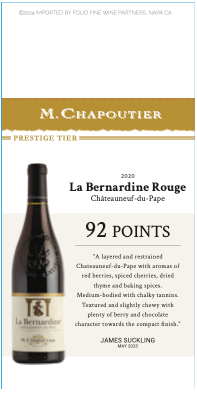
  • 20230505

    92

    points

    James Suckling, May 2023

    "A layered and restrained Chateauneuf-du-Pape with aromas of red berries, spiced cherries, dried thyme and baking spices. Medium-bodied with chalky tannins. Textured and slightly chewy with plenty of berry and chocolate character towards the compact finish. Better after 2025."

    Close Review

    Read Full Review

  • 20221103

    91

    points

    Jeb Dunnuck, November 2022

    "The entry level release from Chapoutier, the 2020 Châteauneuf Du Pape La Bernardine (80% Grenache and the rest Syrah and Mourvèdre) shows the supple, charming, pretty style of the vintage and has medium-bodied aromas and flavors of ripe cherries, framboise, and peppery herbs. This rounded, forward, front end-loaded beauty is perfect for drinking over the coming 7-8 years or more."

    Close Review

    Read Full Review

  • 20240516

    90-92

    points

    Robert Parker's Wine Advocate, May 2024

    "The 2019 Chateauneuf du Pape la Bernardine—Chapoutier's négociant wine from this appellation—is an assemblage of 80% Grenache, 15% Syrah and 5% Mourvèdre, from a mix of soil types. Aged predominantly in concrete, with a small amount in demi-muids of 20 hectoliters, there's a hint of almond on the nose, alongside ripe cherries. Smooth and silky, this full-bodied wine is expansive and supple on the palate, a solid effort."

    Close Review

    Read Full Review

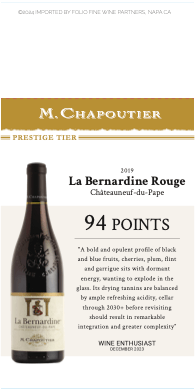
  • 20231201

    94

    points

    Wine Enthusiast, December 2023

    "A bold and opulent profile of black and blue fruits, cherries, plum, flint and garrigue sits with dormant energy, wanting to explode in the glass. Its drying tannins are balanced by ample refreshing acidity, cellar through 2030+ before revisiting should result in remarkable integration and greater complexity. — Anna-Christina Cabrales"

    Close Review

    Read Full Review

  • 20220222

    91

    points

    James Suckling, February 2022

    "Very meaty and savory with discreet red-fruit aromas, this is quite a traditional style of Chateauneuf with some spice. The well-crafted, gentle tannins support the full body without stepping into the foreground, and that makes this very easy to enjoy right now. Mellow finish. Drink or hold."

    Close Review

    Read Full Review

  • 2022-04-30

    93

    points

    Wine Spectator, April 2022

    "Solidly built, with a well-formed core of plum, blackberry and black cherry compote flavors supported by warm earth, anise, plum pit and black tea. The focused finish lets the fruit play out, keeping an underlying freshness in the process. Best from 2023 through 2034"

    Close Review

    Read Full Review

  • 2020-10-06

    90

    points

    Jeb Dunnuck, October 2020

    "Leading off the 2019s from bottle, the entry-level 2019 Châteauneuf Du Pape La Bernardine (80% Grenache, 15% Syrah, and the rest Mourvèdre) offers a Provençal, spicy, morello cherry, and garrigue-scented perfume to go with a medium to full-bodied, ripe yet also savory style on the palate. Drink it over the coming decade."

    Close Review

    Read Full Review

TRADE & MEDIA ASSETS /////////////////

M. Chapoutier La Bernardine Rouge – Accolade Sell Sheet

2020 M. Chapoutier La Bernardine Rouge – 92 points, James Suckling – Shelftalker

2019 M. Chapoutier La Bernardine Rouge – 94 points, Wine Enthusiast – Shelftalker

M. Chapoutier La Bernardine Rouge – Tasting Note

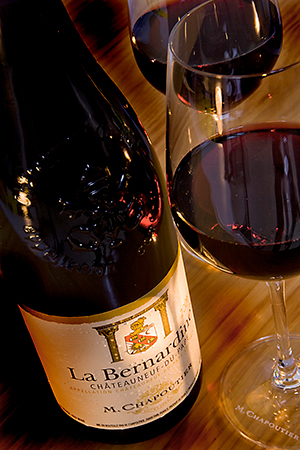
M. Chapoutier La Bernardine Rouge – Beauty – Portrait

M. Chapoutier La Bernardine Rouge – Non-Vintage – Bottle

M. Chapoutier La Bernardine Rouge – Non-Vintage – Label